Showing posts with label j2ee. Show all posts

Java Persistence with Hibernate By Christian Bauer, Gavin King free book download


Java Persistence with Hibernate

http://images.amazon.com/images/P/1932394885.01.LZZZZZZZ.jpg

Product Details
  • Paperback: 904 pages
  • Publisher: Manning Publications; Revised ed. edition (November 24, 2006)
  • Language: English
  • ISBN-10: 1932394885
  • ISBN-13: 978-1932394887
Product Description
Persistence-the ability of data to outlive an instance of a program-is central to modern applications. Hibernate, the most popular Java persistence tool, provides automatic and transparent object/relational mapping making it a snap to work with SQL databases in Java applications. Hibernate applications are cheaper, more portable, and more resilient to change. Because it conforms to the new EJB 3.0 and Java Persistence 1.0 standard, Hibernate allows the developer to seamlessly create efficient, scalable Java EE applications.

Java Persistence with Hibernate explores Hibernate by developing an application that ties together hundreds of individual examples. You'll immediately dig into the rich programming model of Hibernate 3.2 and Java Persistence, working through queries, fetching strategies, caching, transactions, conversations, and more. You'll also appreciate the well-illustrated discussion of best practices in database design, object/relational mapping, and optimization techniques.

In this revised edition of the bestselling Hibernate in Action, authors Christian Bauer and Gavin King-the founder of the Hibernate project-cover Hibernate 3.2 in detail along with the EJB 3.0 and Java Persistence standard.

From the Publisher
Java Persistence with Hibernate is divided into three major parts.

In Part 1, the book introduces the object/relational paradigm mismatch and explains the fundamentals behind object/relational mapping. Then, readers are walked through a hands-on tutorial to get you started with your first Hibernate, Java Persistence, or EJB 3.0 project. You look at Java application design for domain models and at the options for creating object/relational mapping metadata.

Mapping Java classes and properties to SQL tables and columns is the focus of Part 2. You explore all basic and advanced mapping options in Hibernate and Java Persistence, with XML mapping files and Java annotations. It shows you how to deal with inheritance, collections, and complex class associations. Finally, the book discusses integration with legacy database schemas and some mapping strategies that are especially tricky.

Part 3 is all about the processing of objects and how you can load and store data with Hibernate and Java Persistence. The book introduces the programming interfaces, how to write transactional and conversation-aware applications, and how to write queries. It later focuses on the correct design and implementation of layered Java applications, and the most common design patterns that are used with Hibernate, such as the Data Access Object (DAO) and EJB Command patterns. You'll see how you can test your Hibernate application easily and what other best practices are relevant if you work an object/relational mapping software.

Finally, you are introduced to the JBoss Seam framework, which takes many Hibernate concepts to the next level and enables you to create conversational web applications with ease.

Visit the Manning site for sample chapters, the Author Online Forum, errata and source code forJava Persistence with Hibernate.
For more free books download visit this blog daily

For the Broken Links and Like this Book reply Here....

Download

Complete Java 2 certification: study guide By Philip Heller, Simon Roberts free book download


The Complete Java 2 Certification Study Guide: Programmer's and Developers Exams
http://images.amazon.com/images/P/0782142761.01.LZZZZZZZ.jpg

Product Details

  • Hardcover: 899 pages
  • Publisher: Sybex Inc; 2nd edition (September 14, 2000)
  • Language: English
  • ISBN-10: 0782128254
  • ISBN-13: 978-0782128253
Newly revised and updated for Java 2 standards, the second edition of The Complete Java 2 Certification Study Guide is packed with information on what you'll need to know to pass both the Sun Java Programmer and Developer Exams. With Java certification becoming ever more popular, this title is an essential resource for anyone who's preparing for it.

The cover of the book asserts that one of its team authors actually contributes questions to Sun's tests.

The goal here isn't so much to beat the testmakers (although the book has plenty to say about test-taking strategy) as it is to master the finer points of Java that you'll need to understand to succeed on the exam. The focus is on the areas that Sun has defined as important. The Programmer Exam--the first level of Sun certification--is covered first. Basic language features are reviewed, such as access specifiers, operators, and other keywords that will help make you an expert. (Some sections explain with great clarity the mysteries of Java's "extra" shift operator and other features.) Other chapters cover threads and multithreading strategies, as well as user-interface design with layout managers (which Sun considers important).

The second half of the volume concentrates on the Developer Exam, a more free-form exercise in which programmers write custom code, based on a specification from Sun. Two case studies, one for a room-scheduling application and another for a trouble-ticket system that tracks requests for technical support, illustrate this test. As the solution is presented, you'll learn how to build custom client/server software, and how to use Remote Method Invocation (RMI) and other advanced techniques. There's also advice for the best programming styles and choices for passing this challenging exam.

As in the previous edition, each chapter in this book concludes with sample questions (about 10 each) to help you study. In the new edition, there's now a full sample Programmer Exam (both printed and on the accompanying CD-ROM), which simulates the length and format of the real thing. In all, the new edition of this previously bestselling title will continue to provide helpful preparation for anyone who seeks Sun certification.

Despite the bulk (over 900 pages), this book actually makes for quick reading, and will help anyone decipher some of the more difficult aspects of the Java programming language. --Richard Dragan

Topics covered:

  • Introduction to Sun certification and the Programmer Exam
  • Java language fundamentals: primitive data types, literals, arrays, and garbage collection
  • Java operators up close (including evaluation order and the shift operators)
  • Access specifiers (public, private, default, and protected)
  • Converting and casting rules in Java (including promotions)
  • Flow-control statements
  • Exception handling
  • Object-oriented design primer
  • Overloading and overriding
  • Inheritance and subclassing
  • Inner classes
  • Threads and synchronization techniques
  • Using the Math, String, and StringBuffer classes effectively
  • The Java 2 Collections API
  • Layout managers
  • Event handling
  • AWT components
  • Painting
  • File I/O
  • Introduction to the Sun Developer Exam
  • Sample room-reservation case study
  • Working with Java databases
  • Creating a client/server system from scratch
  • Remote Method Invocation (RMI)
  • Multithreading issues
  • User-interface design with Swing
  • Trouble-ticket problem tracker case study
  • Using Swing JTable, JTree, and other Swing controls
  • How to submit finished exam work to Sun
  • Tips for the follow-up exam
  • Sample Programmer Exam (including CD-ROM version)
  • The future of Sun certification

Product Description
Welcome to the completely revised edition of the market-leading Java exam preparation guide from Sybex! Authors Simon Roberts (the lead author of the Java exams), Philip Heller, and Michael Ernest have completely revamped their book, writing five new chapters on the tough Developer's exam and adding lots of new questions (200 new ones in the book and on the CD). In response to reader feedback, we've cut out the long API reference that was in the previous edition and replaced it with more meaningful content. Finally, the CD now contains a fully search able electronic edition of the book.


For more free books download visit this blog daily

For the Broken Links and Like this Book reply Here....

Download

Struts: The Complete Reference free book download


Struts: The Complete Reference

http://i9.tinypic.com/4xm49j5.jpg
Product Details
  • Paperback: 800 pages
  • Publisher: McGraw-Hill Osborne Media; 2 edition (December 11, 2006)
  • Language: English
  • ISBN-10: 0072263865
  • ISBN-13: 978-0072263862
Book Description

Strut your stuff with this completely up-to-date guide

Struts guru James Holmes has completely revised and updated his definitive, bestselling Struts volume. You will get soup-to-nuts coverage of Struts 1.3, the latest version of the framework used to create flexible, high-performance web applications. The book features insider tips, tricks, and techniques to make Struts applications sizzle.


From the Back Cover

Start-to-Finish Coverage of Every Aspect of Struts 1.3

Build next-generation Java-based Web applications using Struts and the comprehensive information contained in this authoritative volume. Written by James Holmes, a committer on the Struts project, and fully updated to include the latest features of Struts 1.3, Struts: The Complete Reference is really three books in one: an in-depth tutorial, a broad reference, and an advanced developer's guide.

Learn to write high-performance Struts applications and internationalize, test, and secure them. Plus, get in-depth coverage of Tiles, Validator, the Struts tag libraries, the Struts configuration files, and AJAX. Throughout, you'll find real-world examples, cutting-edge techniques, and insider tricks that will make your Struts applications sizzle.


Download
OR
Download

Free download : Java 2 Enterprise Edition 1.4 Bible


Product Details
  • Paperback: 1008 pages
  • Publisher: Wiley (August 22, 2003)
  • Language: English
  • ISBN-10: 0764539663
  • ISBN-13: 978-0764539664
Book Description
* Java 2 Enterprise Edition (J2EE) is the specification that all enterprise Java developers need to build multi-tier applications, and also the basis for BEA's WebLogic Application Server and IBM's WebSphere
* Revised to be current with the significant J2EE 1.4 update that will drive substantial developer interest
* Written by a top-selling team of eleven experts who provide unique and substantial business examples in a vendor-neutral format, making the information applicable to various application servers
* Covers patterns, J2EE application servers, frameworks, Ant, and continuous availability
* Includes extensive intermediate and advanced coverage of J2EE APIs
* Companion Web site provides additional examples and information


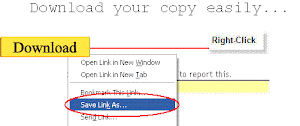
Go to the page and save the file as (.pdf)

Free download : Developing Java Beans


Product Details

  • Paperback: 312 pages
  • Publisher: O'Reilly Media, Inc.; 1st ed edition (June 1, 1997)
  • Language: English
  • ISBN-10: 1565922891
  • ISBN-13: 978-1565922891
O'Reilly books are rarely for neophytes, but advanced users swear by them, and these will be no exception. Englander covers a hot Java subtopic for students, programmers, and professionals already familar with Java and object-oriented programming. He discusses events, event adapters, properties, persistence, java archive files, the BeanBox tool, property editors, ActiveX, and the java.beans Package. Flanagan's work is the book Java programmers want nearby when they are at the keyboard. A complete ready-reference work, this belongs in all collections supporting programmers. Java is a constantly changing language so Nutshell will be coming out often with new editions; always have the newest one on hand. Reese goes beyond simple applet design to relational databases, SQL, object-oriented database applications, application servers, and remote object manipulation. The examples used throughout the book are based on a banking application designed in Java.
Copyright 1997 Reed Business Information, Inc.

Product Description
Java Beans is the most important new development in Java this year. Beans is the next generation of Java technology that not only adds features the language lacked, but also lets Java programs interoperate with a number of development environments. The initial release includes a bridge for Microsoft's ActiveX/COM; future releases will include bridges for Netscape's LiveConnect and IBM's OpenDoc. Since it's a "component architecture" for Java, Beans can be used in graphical programming environments, like Borland's JBuilder, or IBM's VisualAge for Java. This means that someone can use a graphical tool to connect a lot of Beans together and make an application, without actually writing any Java code -- in fact, without doing any programming at all. Graphical development environments let you configure components by specifying aspects of their visual appearance (like the color or label of a button) in addition to the interactions between components (what happens when you click on a button or select a menu item). One important aspect of Java Beans is that components don't have to be visible. This sounds like a minor distinction, but it's very important: the invisible parts of an application are the parts that do the work. So, for example, in addition to manipulating graphical widgets, like checkboxes and menus, Beans allows you to develop and manipulate components that do database access, perform computations, and so on. You can build entire applications by connecting pre-built components, without writing any code. Developing Java Beans is for people who need to stay up-to-date with the latest developments in programming technology. Minimally, developing Beans means adopting several simple design patterns in your code. However, that's only the beginning. To take full advantage of the Java Beans architecture, you should understand how to write classes that are serializable, use events for communication between classes, know when and how to provide BeanInfo classes that give graphical environments more information about your components, and provide property editors and customizers that let graphical tools work with more complex Beans. The book covers:
  • Events, event listeners, and adapters
  • Properties, indexed properties, bound properties, constrained properties, and vetoable property changes
  • Persistence, serialization, versioning, and object validation
  • Packaging Beans using JAR files
  • The BeanBox, a prototypical development tool
  • Reflection and introspection
  • Property editors and customizers
  • The ActiveX bridge; using Java Beans in Visual Basic programs


Go to the web and save the file as (.pdf)

WebLogic Server 6.1 Workbook for Enterprise JavaBeans free book download


Product details
  • Paperback: 256 pages
  • Publisher: O'Reilly; 3Rev Ed edition (4 Sep 2002)
  • Language English
  • ISBN-10: 0596004176
  • ISBN-13: 978-0596004170

Product Description
Synopsis
Although EJB applications themselves are portable, the manner in which developers install and run EJB products varies widely from one vendor to the next. The goal of this Web Logic workbook is to discuss vendor specific requirements and best practices and introduce tools like the WebLogic Administration Console, all in the contest of building and running the example programs for O'Reilly's "Enterprise JavaBeans", 3rd edition. The Workbook guides you step-by-step, explaining how to build and deploy working solutions in a particular application server, and provides useful hints, tips and warnings.


Go to the web and save the file as (.pdf)


Try More Free Books

CATEGORIES

If you get any link broken please inform me. I will solv the problem within 24 hours.For contact with me Click here.

Top Commenters

Widget by SamSumon
    If you enjoyed this post, make sure you subscribe as an Reader!